 ReceGuard

Quick answer: which countries are tax havens?
There is no single official list, and the two most cited ones barely overlap. The EU list of non-cooperative jurisdictions, last revised on 17 February 2026, names ten: American Samoa, Anguilla, Guam, Palau, Panama, Russia, the Turks and Caicos Islands, the US Virgin Islands, Vanuatu and Viet Nam. The Tax Justice Network's Corporate Tax Haven Index is led instead by the British Virgin Islands, the Cayman Islands, Switzerland, Bermuda and Singapore.
For individuals and small businesses, the practical point is simpler: holding money or a company abroad is generally legal, but not declaring it is not. Tax authorities now receive data on foreign accounts automatically from more than a hundred jurisdictions.
Key takeaways
- The EU list judges whether a jurisdiction cooperates on tax transparency, not how low its tax rates are.
- Independent rankings measure how much a jurisdiction enables tax avoidance, so they include large economies the EU list never does.
- Under the Common Reporting Standard, 116 jurisdictions already exchange foreign account data automatically.
- US persons must file an FBAR when foreign accounts together exceed $10,000 at any point in the year.
- The 15% global minimum tax targets multinational groups with revenue of at least EUR 750 million, not freelancers.
What makes a country a tax haven?
A tax haven is usually described as a jurisdiction that combines low or zero tax for foreign money with secrecy and little requirement for real economic activity. But each list picks its own test. Governments tend to focus on cooperation: does the jurisdiction exchange information with other tax authorities, and does it run harmful preferential regimes? Independent researchers tend to focus on outcomes: how much corporate profit or private wealth actually flows through it, and how far its laws let that money escape tax.
That difference explains almost every surprise on the lists below.
Which countries are on the EU tax haven blacklist?
The Council of the EU updates its list of non-cooperative jurisdictions for tax purposes twice a year. At its 17 February 2026 revision it added the Turks and Caicos Islands and Viet Nam and removed Fiji, Samoa and Trinidad and Tobago. The next revision is due in October 2026.
| EU list (Annex I): non-cooperative | EU grey list (Annex II): commitments pending |
|---|---|
| American Samoa, Anguilla, Guam, Palau, Panama, Russia, Turks and Caicos Islands, US Virgin Islands, Vanuatu, Viet Nam | Belize, British Virgin Islands, Brunei Darussalam, Eswatini, Greenland, Jordan, Montenegro, Morocco, Türkiye |
Two things stand out. The list contains no EU member state, by design: it only assesses third countries. And it reacts to cooperation rather than tax rates, which is why a zero-tax territory can stay off it as long as it shares information.
Which countries top the independent rankings?
The Tax Justice Network's Corporate Tax Haven Index scores jurisdictions on how much room their laws give multinationals to underpay tax, weighted by how much corporate investment passes through them. It is now updated on a rolling basis. At the time of writing, the top ten are:
| Rank | Jurisdiction | Rank | Jurisdiction |
|---|---|---|---|
| 1 | British Virgin Islands | 6 | Hong Kong |
| 2 | Cayman Islands | 7 | Netherlands |
| 3 | Switzerland | 8 | Jersey |
| 4 | Bermuda | 9 | Ireland |
| 5 | Singapore | 10 | Luxembourg |
Its sister index on private wealth, the Financial Secrecy Index, puts the United States first, followed by Switzerland, Singapore, Hong Kong and Luxembourg. The US alone accounts for about a quarter of the global supply of offshore financial services in that index.
Why do the lists disagree so much?
Because they answer different questions. The EU list asks whether a country plays by agreed transparency rules; Panama and Vanuatu fail that test, while Switzerland and Singapore pass it because they exchange information. The independent indexes ask where tax avoidance actually happens at scale; large, cooperative financial centres dominate there precisely because so much money moves through them. Neither list is "the" list. Which one matters to you depends on the question: a government blacklist triggers legal consequences, while an index describes economic reality.
Is it legal to keep money in a tax haven?
Generally, yes. Owning a foreign account, investment or company is lawful in most countries. What is illegal is hiding the income or assets from the tax authority where you are resident. In the United States that line is drawn by reporting rules:
- FBAR (FinCEN Form 114). A US person must file an FBAR if the combined value of their foreign financial accounts exceeded $10,000 at any time during the year. It is due April 15, with an automatic extension to October 15, and the account records must be kept for five years.
- Form 8938 (FATCA). An unmarried taxpayer living in the US must attach Form 8938 when specified foreign financial assets exceed $50,000 on the last day of the year or $75,000 at any time. Failing to file can cost a $10,000 penalty.
- Worldwide income. US citizens are taxed on their worldwide income wherever they live, as IRS Publication 54 explains. Moving to a zero-tax country does not by itself end a US filing obligation.
Can a tax authority still see foreign accounts?
Increasingly, yes, and automatically. Under the OECD's Common Reporting Standard, banks report foreign customers' accounts to their own tax authority, which forwards the data to the customer's home country. Tax authorities in 116 jurisdictions have started these exchanges, and in 2024 they swapped data on more than 171 million accounts worth nearly EUR 13 trillion. The United States runs its own system, FATCA, instead.
For multinationals, the global minimum tax agreed by more than 135 jurisdictions sets a 15% floor on profits in every country where a group operates. It only applies to groups with consolidated revenue of at least EUR 750 million, so it changes nothing for a freelancer or small business directly.
What does this mean for a freelancer or small business?
Mostly, it means records. If you invoice foreign clients, pay foreign suppliers or hold a foreign account, the expectations are the same as at home: report the income, keep the evidence for each expense, and know which forms your residence country requires for assets abroad. Be wary of schemes that sell an offshore company as a way for a one-person business to stop paying tax at home. Where you live and work usually decides where you are taxed, and the account data now travels whether you report it or not.
The everyday habits are the ones in our receipt organization guide: capture each receipt when you get it, note the business purpose, and keep it for as long as the rules require, which our guide on how long to keep receipts covers country by country. If a foreign receipt goes missing, the steps in proving an expense without a receipt still apply.
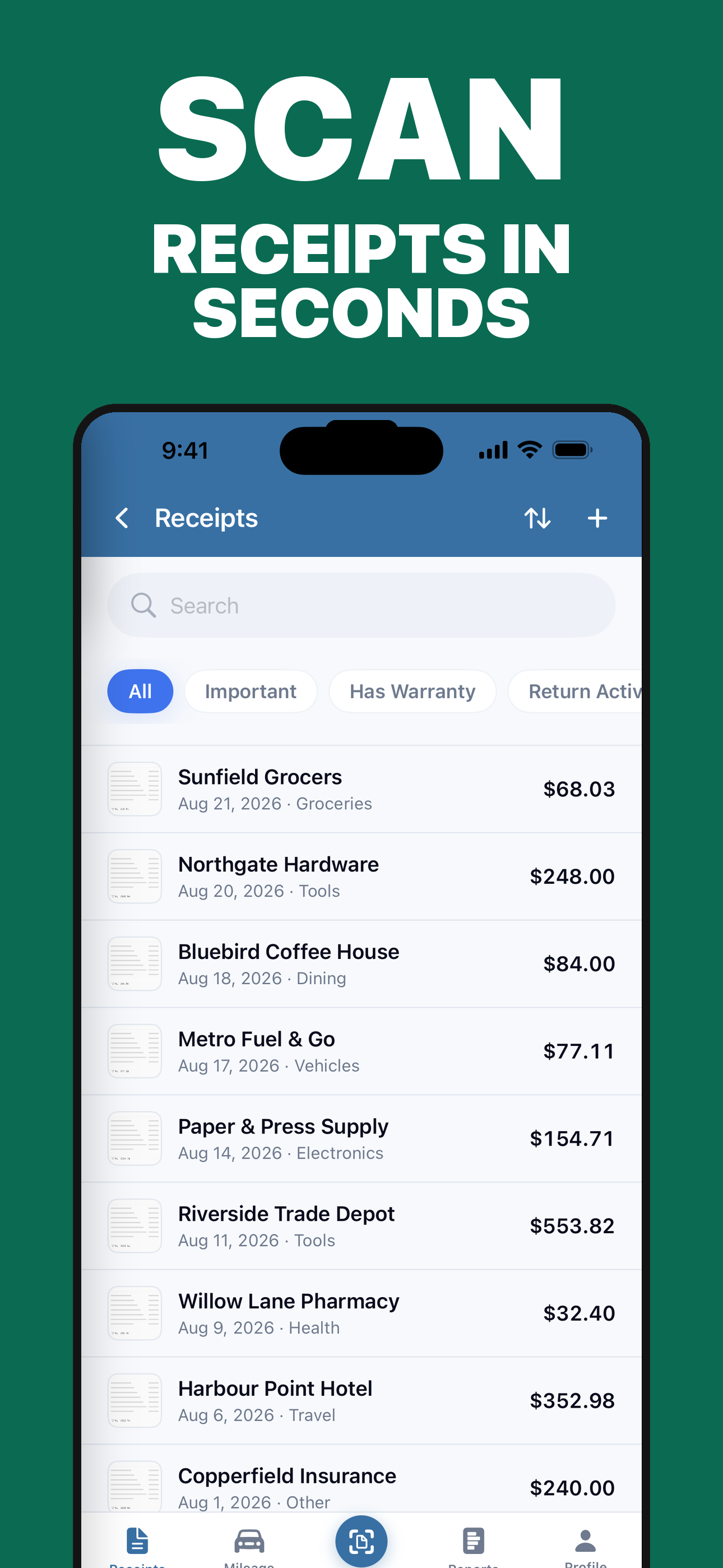
Where ReceGuard fits: scan each receipt when you get it, at home or abroad, and add the business purpose while you remember it. The merchant, date and amount are read on your iPhone and filed with the image, so the evidence behind every deduction stays in one place you control.
Frequently asked questions
Is Switzerland a tax haven?
It depends on the list. Switzerland is not on the EU list of non-cooperative jurisdictions, because it exchanges tax information with other countries. But it ranks third on the Tax Justice Network's Corporate Tax Haven Index and second on its Financial Secrecy Index, which measure how much tax avoidance and financial secrecy a jurisdiction enables in practice.
Is the United States a tax haven?
The United States ranks first on the Tax Justice Network's Financial Secrecy Index, which measures how much a jurisdiction supplies financial secrecy to non-residents. It is not on the EU list. The US does not take part in the OECD Common Reporting Standard and uses its own FATCA system instead.
Is it illegal to have an offshore bank account?
No. In most countries it is legal to hold a bank account, investment or company abroad. It becomes illegal when the income or the account is hidden from the tax authority where you are resident. In the US, foreign accounts worth more than $10,000 in total at any time during the year must be reported on an FBAR.
How often is the EU tax haven list updated?
Twice a year, usually in February and October. The latest revision on 17 February 2026 added the Turks and Caicos Islands and Viet Nam and removed Fiji, Samoa and Trinidad and Tobago. The next revision is due in October 2026.
Does moving to a zero-tax country mean I pay no tax?
Not necessarily. Your home country may still tax you depending on its residence or citizenship rules. US citizens are taxed on worldwide income wherever they live, and several European countries keep treating people who move to a listed tax haven as taxpayers for years afterwards.
Sources
- Council of the EU: Council updates the EU list of non-cooperative jurisdictions (17 February 2026)
- Council of the EU: EU list of non-cooperative jurisdictions for tax purposes
- Tax Justice Network: Corporate Tax Haven Index, full list
- Tax Justice Network: Financial Secrecy Index
- OECD: Peer Review of the Automatic Exchange of Financial Account Information, 2025 update
- OECD: Global minimum tax, implementing jurisdictions (May 2026)
- IRS: Report of Foreign Bank and Financial Accounts (FBAR)
- IRS: Do I need to file Form 8938?
- IRS: Publication 54, Tax Guide for U.S. Citizens and Resident Aliens Abroad
This article is general information, not tax or legal advice. Lists and rules change; a qualified tax professional should make the final call on your situation.
Scan receipts, log mileage and export a tax package when you need one.
Download ReceGuard