 ReceGuard

Quick answer: can you deduct an expense if you lost the receipt?
Usually, yes. The IRS asks you to prove the expense: what you paid, when, to whom, and why it was for your business. A receipt is the easiest proof, not the only one. Ask the merchant for a duplicate first; if that fails, combine your card or bank statement with other evidence (an order confirmation, a calendar entry, a photo of the item) and write a short dated note explaining what happened.
The exception is travel, gifts, car expenses and business meals. For those, the regulations require documentary evidence for lodging at any price and for any other single expense of $75 or more, and courts cannot estimate the amount for you.
Key takeaways
- The deduction depends on proving the expense, not on one specific piece of paper.
- A card statement proves payment but not what you bought or why; on its own it is usually not enough.
- For travel, gifts, car expenses and meals, lodging always needs a receipt, and so does any other item of $75 or more.
- There is no official IRS “lost receipt” form; a dated note you write yourself is supporting evidence, not a substitute.
- The Cohan rule lets a court estimate some expenses, but it is a last resort and does not apply to travel, gifts or car expenses.
Does the IRS require a receipt for every business expense?
No. Federal tax law requires you to keep records that are sufficient to show your income and deductions, and IRS guidance on what kind of records to keep lists receipts alongside canceled checks, account statements, invoices and credit card slips. For ordinary expenses — office supplies, software, a replacement phone charger — the question is whether your records as a whole show the amount, the date, the payee and the business purpose.
The stricter rules sit in section 274(d) of the tax code, which covers travel away from home, gifts and listed property such as cars. The IRS applies the same substantiation elements to business meals in Publication 463. Under Treasury Regulation §1.274-5(c)(2)(iii), documentary evidence such as a receipt or paid bill is required for any lodging expense while traveling away from home, and for any other expenditure of $75 or more.
| Expense type | What you must be able to show | If the receipt is gone |
|---|---|---|
| Ordinary expenses (supplies, software, tools) | Amount, date, payee, business purpose | Duplicate from the seller, or statement plus other evidence and a note |
| Business meal or travel item under $75 | Amount, date, place, business purpose (and who attended, for meals) | A written record made at or near the time can stand in for the receipt |
| Business meal or travel item of $75 or more | The same elements, plus documentary evidence | Get a duplicate; without one, the deduction is at real risk |
| Hotel or other lodging while traveling | Documentary evidence at any amount | Ask the hotel for a folio; most can reissue one from your booking |
| Car expenses | Mileage log with dates, destinations and purpose | See our mileage log guide; a log cannot be estimated later |
What should you do first when a receipt goes missing?
Get a copy from the merchant before trying anything else. A duplicate issued by the seller is the same kind of evidence as the original, while every other option is something you assembled yourself. Work through these in order:
- Search your email and accounts. Online orders, subscriptions, rideshares, airlines and hotels almost always send an electronic receipt or keep one in your account history. Search your inbox for the merchant name and the amount.
- Ask the merchant for a reprint. Many retailers can look up a transaction by the card used, the date and the store, and reprint it. Service providers can resend an invoice. Do it quickly; some point-of-sale systems only keep searchable history for a limited time.
- Download the card or bank statement. It proves the date, the amount and the merchant name, which are three of the elements you need.
- Collect corroborating evidence. A calendar entry for the client meeting, the email that set it up, a photo of the equipment you bought, a delivery confirmation or a project file that shows the item in use.
- Write a dated note. Record what was bought, why, and what happened to the receipt (see the template below), then file it with everything else.
Is a bank or credit card statement enough without the receipt?
Usually not on its own. IRS Publication 583 is direct about it: proof of payment of an amount, by itself, does not establish that you are entitled to a deduction, and you should also keep documents such as invoices and sales slips to show you incurred the cost. A statement line reading “HOME DEPOT #4410 — $184.37” proves you paid a hardware store. It does not show whether you bought shelving for your workshop or a grill for your patio.
A statement becomes strong evidence once something else supplies the missing half: an order confirmation listing the items, a client email referring to the purchase, or a note written at the time. The combination is what does the work.
What should a lost-receipt note include?
There is no official IRS form for a missing receipt, so the note is your own record. Its value comes from being specific, being written close to the date of the purchase, and pointing to independent evidence. Keep it short and factual:
Lost receipt note — template
Date of purchase: 14 March 2026
Merchant and location: Office Depot, 1200 Main St, Springfield
Amount: $92.40, paid with business Visa ending 4417
Items: two toner cartridges and a ream of printer paper
Business purpose: supplies for client proposal printing
What happened to the receipt: thermal receipt faded before it was filed; store could not reprint it
Supporting evidence: card statement line dated 14 March 2026; order history screenshot
Written on: 20 March 2026
The “written on” line matters. A note made the following week is a near-contemporaneous record. The same note written after an audit letter arrives is a reconstruction, and it will be treated with far more skepticism. For meals, add who attended and their business relationship to you, because those elements have no other source.
What is the Cohan rule, and can you rely on it?
The Cohan rule comes from Cohan v. Commissioner, a 1930 decision of the Second Circuit involving the entertainer George M. Cohan. It lets a court estimate a deductible expense when the evidence shows the taxpayer clearly spent the money, even though exact records are missing. It is a real protection, but a weak one to plan around, for three reasons:
- The court needs a reasonable basis. Under Vanicek v. Commissioner (1985), if there is no rational basis for an estimate, nothing is allowed, even when some expense obviously occurred.
- Estimates lean against you. Courts applying Cohan typically weigh heavily against the taxpayer whose recordkeeping created the uncertainty, so the estimate is often well below what you actually spent.
- It does not apply to section 274(d) items. Travel, gifts and car expenses must be substantiated; they cannot be estimated. This is why a missing mileage log is so much more costly than a missing receipt for printer ink.
What if your records were destroyed in a fire, flood or theft?
The rules are more forgiving when losing the records was outside your control. Regulation §1.274-5T(c)(5) gives taxpayers the right to substantiate even travel, gift and car deductions by reasonable reconstruction when records were lost through circumstances beyond their control, such as fire, flood, earthquake or other casualty. The IRS publishes practical guidance on reconstructing records after a disaster: request statement copies from your bank and card issuers, ask suppliers and clients for copies of invoices, and document the event that destroyed the originals.
“Beyond your control” means an actual casualty. A receipt that faded in a wallet or went through the washing machine does not qualify, which is one more reason to digitize receipts as soon as you get them.
How do you stop losing receipts in the first place?
Capture the receipt at the moment you are handed it. Thermal paper fades, wallets get emptied, and a stack of loose receipts is exactly where the $75 one goes missing. The IRS has accepted electronic records since Revenue Procedure 97-22, provided they are legible and can be reproduced in hard copy; our guide to scanning receipts on iPhone covers what a usable scan needs. A weekly ten-minute review, as described in our receipt organization system, catches missing receipts while the merchant can still reprint them. And for anything unusual, the free receipt documentation helper walks through what supporting evidence a purchase should have.
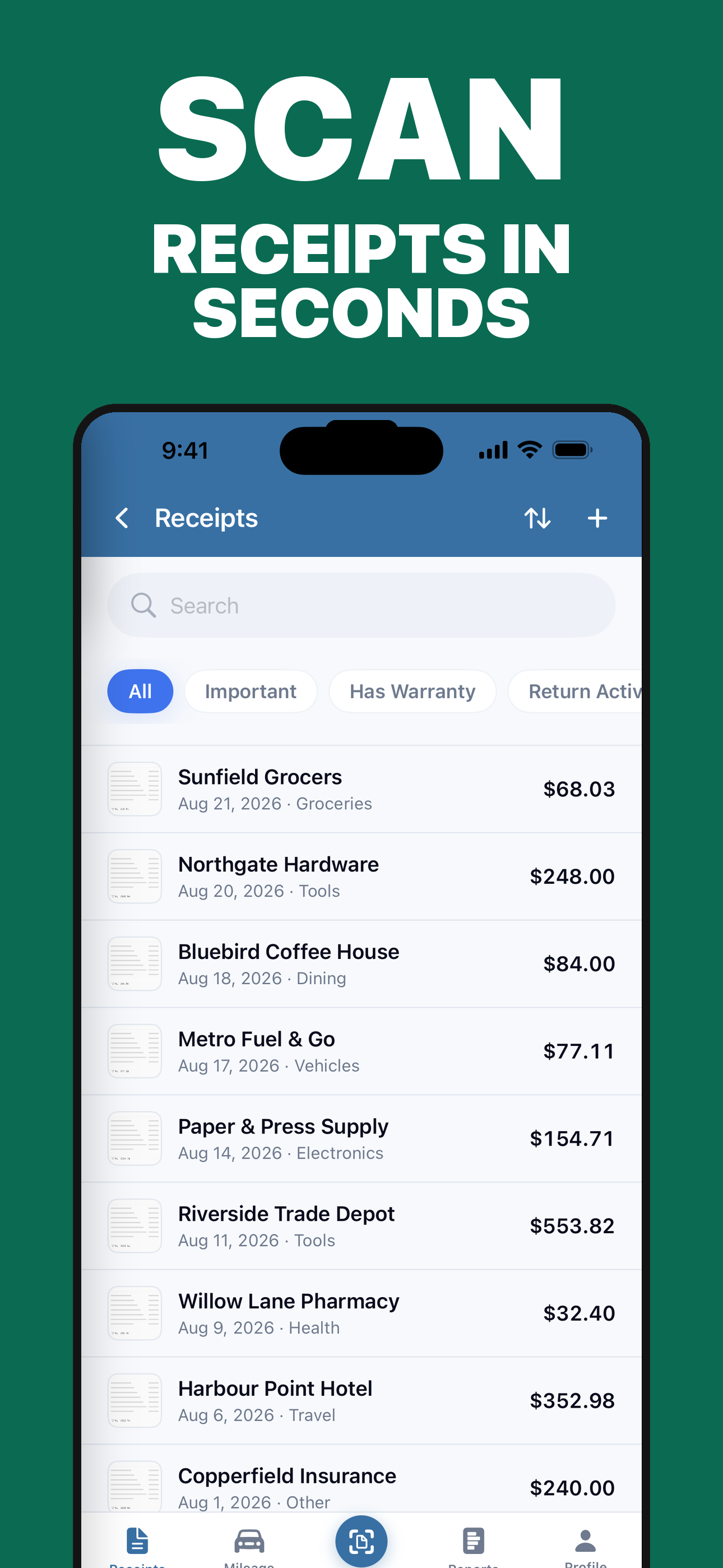
Where ReceGuard fits: scan the receipt at the till, add the business purpose while you still remember it, and the amount, date and merchant are read on your iPhone and filed with the image. If a receipt does go missing, create the entry anyway with the card details and a note of what happened, so the gap is documented the week it occurs instead of the week of an audit.
Frequently asked questions
Can I deduct a business expense without a receipt?
Often, yes. The IRS requires you to prove the expense, not to produce one specific piece of paper. For most ordinary expenses, a card statement combined with other evidence of what you bought and why can support the deduction. The stricter rules for travel, gifts, car expenses and business meals are the main exception: there, documentary evidence is required for lodging and for any other single expense of $75 or more.
Is a credit card statement enough proof for the IRS?
On its own, usually not. IRS Publication 583 says proof of payment, by itself, does not establish that you are entitled to a deduction. A statement proves you paid a merchant a certain amount on a certain date; it does not show what you bought or why it was a business expense. Pair it with an order confirmation, an invoice copy, a calendar entry or a written note.
Is there an official IRS lost receipt form?
No. There is no IRS form for a missing receipt. A lost-receipt note or affidavit is simply your own written record of the expense. It carries the most weight when you write it close to the date of the purchase and when it is backed by independent evidence such as a card statement.
What is the Cohan rule?
The Cohan rule comes from a 1930 federal appeals case and lets a court estimate a deductible expense when it is clear the taxpayer spent the money but exact records are missing. The court needs a reasonable basis for the estimate, and it usually leans against the taxpayer whose own recordkeeping created the uncertainty. It cannot be used for travel, gifts or car expenses covered by section 274(d).
Can I ask a store for a copy of a lost receipt?
Yes, and it is the best first step. Many retailers can look up a card transaction and reprint the receipt, and online orders, subscriptions, airlines and hotels usually keep an invoice in your account or in your email. A duplicate from the merchant is far stronger evidence than any reconstruction you write yourself.
Sources
- IRS: Publication 583, Starting a Business and Keeping Records
- IRS: What kind of records should I keep
- IRS: Publication 463, Travel, Gift, and Car Expenses
- eCFR: 26 CFR §1.274-5, Substantiation requirements
- eCFR: 26 CFR §1.274-5T, Substantiation requirements (temporary)
- IRS: Reconstructing records after a natural disaster or casualty loss
- IRS: Revenue Procedure 97-22, electronic storage of records
- Cornell Law School LII: Cohan rule
This article is general recordkeeping information, not tax advice. Rules change and circumstances differ; a qualified tax professional should make the final call on your return.
Scan receipts, log mileage and export a tax package when you need one.
Download ReceGuard