 ReceGuard

An invoice is a request for payment sent before or at the time of a sale. A receipt is confirmation that payment has been made. For a business expense you want the receipt, or a paid invoice, because it proves the money left your account; for income you keep the invoices you issued and a record of the payment that settled them.
- Invoice = amount due; receipt = amount paid. One document can be both once it is marked paid.
- The IRS has no single required format. It wants evidence of the amount, date, place and business purpose of each expense.
- If you use the cash method, as most freelancers do, income counts when you receive it, not when you send the invoice.
- A bank or card statement proves payment but not what you bought, so keep it with the invoice or receipt rather than instead of it.
What is the difference between a receipt and an invoice?
An invoice is issued by the seller to ask for payment; a receipt is issued after payment to confirm it. They answer two different questions. The invoice answers “what do I owe, to whom, and by when?” The receipt answers “did this get paid, how much, and on what date?”
That difference shows up in the details. An invoice normally carries an invoice number, the seller’s and buyer’s details, a description of the work or goods, the amount, any tax, and payment terms such as “due in 30 days”. A receipt carries the date and amount of payment, the payment method and the merchant. A till slip from a shop is a receipt. The PDF a contractor emails you before you pay is an invoice. The same PDF stamped “paid” with a payment date is, for most practical purposes, both.
| Invoice | Receipt | |
|---|---|---|
| Purpose | Requests payment | Confirms payment |
| Issued | Before or when payment is due | After payment is made |
| Key details | Invoice number, parties, items, amount due, terms | Date paid, amount paid, payment method, merchant |
| Proves | A debt or a sale | That the money changed hands |
| Typical example | A freelancer’s bill to a client | A shop slip or a payment confirmation |
Which one proves a business expense to the IRS?
The one that shows you paid, and shows what you paid for. The IRS does not prescribe a form. Its guidance on recordkeeping for small businesses says that you must be able to substantiate expenses with documents such as canceled checks, receipts and invoices, and that supporting documents should show the amount paid and proof that it was a business expense.
For travel, gifts and similar expenses, IRS Publication 463 sets a hard line: you need documentary evidence, such as a receipt or paid bill, for any expense of $75 or more, and for every lodging expense. Under $75 you still need a record of the amount, date, place and business purpose, but a written note can stand in for the slip. A bare invoice you have not paid is weaker evidence than a paid one, because it proves you were billed, not that you paid.
Because most freelancers use the cash method, you deduct an expense in the year you pay it. The date of payment therefore matters more than the date on the invoice. A software bill dated 28 December and paid on 3 January belongs in the following year’s deductions on the cash method, and your records need to show both dates.
Which one proves income, and when does income count?
For income, keep the invoices you issue together with the record of the payment that settled each one. The IRS lists invoices, bank deposit slips, receipt books and Forms 1099 among the documents that support gross receipts in Publication 583. The invoice shows what you billed; the deposit shows what actually arrived.
When income counts depends on your accounting method. Publication 538 explains that under the cash method you include income when you actually or constructively receive it, so an invoice sent in December and paid in January is January income. Under the accrual method, income is generally counted when you earn the right to it, which for most invoices means when it is issued. If you are unsure which method you use, ask your tax adviser before the first return you file; changing later requires IRS consent.
Two practical consequences follow. First, number your invoices in sequence and never delete one: gaps invite questions. Second, when a client pays several invoices in one transfer, write down which invoices that deposit covers, because the bank line alone will not tell an examiner. The free invoice generator numbers invoices and produces a clean PDF if you do not have a template yet.
Can a single document be both an invoice and a receipt?
Yes, and most online purchases work that way. A SaaS subscription, a domain renewal or an app purchase usually produces a document headed “Invoice” or “Receipt” that lists the items, the total and the card that was charged. Because it records both the amount and the payment, it covers both jobs.
The test is simple: does the document show that the money was actually paid? Look for a payment date, a payment method (for example the last four digits of a card), and words such as “paid” or “amount due: $0.00”. If the document only says “amount due” and a due date, it is an unpaid invoice, and you need a second record when you pay it, such as the confirmation page, the vendor’s receipt email or the statement line.
A purchase receipt generator is useful when you sell something yourself and the customer wants proof of payment on the spot. Use it for your own sales, never to recreate a supplier’s receipt you have lost. For that situation, read how to still prove a business expense.
What details should each document contain?
Enough that a stranger could understand the transaction years later. Use these as checklists when you create a document yourself or check one you have received.
| A good invoice shows | A good receipt shows |
|---|---|
| Unique invoice number and issue date | Date of payment |
| Seller and buyer name and address | Merchant name and location |
| Description of the goods or services, quantities, unit prices | What was bought, even in summary form |
| Subtotal, any sales tax, total due | Total paid, sales tax if charged |
| Due date and payment terms | Payment method, such as card ending 4242 |
| How to pay (bank details or payment link) | A reference you can match to the statement |
Then add the one detail no supplier can print for you: the business purpose. A line such as “Client workshop, Denver, 14 Oct” on the receipt record turns a coffee-shop slip into a defensible expense. Our business expense record builder produces that note in a consistent format.
What does this look like in a real month?
Take a freelance web designer who uses the cash method. In October she issues invoice 2026-041 for $1,800 to a client, payable in 30 days. She also pays $240 for a year of web hosting on her business card, and gets an emailed document headed “Invoice” that shows the card charge.
| Event | Document | What it proves | Counts for tax when |
|---|---|---|---|
| She bills the client $1,800 | Her invoice 2026-041 | The sale and the amount owed | Not yet, on the cash method |
| Client pays on 9 November | Bank deposit line plus the invoice | Payment received, matched to the invoice | November income |
| She buys hosting for $240 | Vendor invoice showing the card charge | Invoice and receipt in one | Deducted in the year paid |
| She has coffee with a prospect for $14 | Till slip plus a note on purpose | Small expense, below the $75 threshold | Deducted subject to the usual meal limits |
Each row ends with two records stored together: the document and a note linking it to the payment or business purpose. That link is what lets her answer questions later without reconstructing the month from memory.
Are bank statements, order confirmations and packing slips enough?
Usually not on their own, because each proves only part of the story. A card statement proves that money moved and to whom, but not what you bought. An order confirmation proves intent to buy, not that payment went through. A packing slip proves delivery and often has no prices at all.
- Card or bank statement: good proof of payment and date. Pair it with the invoice or an itemized receipt.
- Order confirmation email: usually lists the items and total. Accept it as a receipt only if it shows the payment was taken.
- Packing slip or delivery note: supports that goods arrived. Keep it only if it is the sole record of what was ordered.
- Payment app history (PayPal, Stripe, Venmo): a transaction record is evidence of payment. Download the itemized receipt where one exists.
If the original is gone, a statement is a reasonable starting point for rebuilding the record, but it should not be your system. Our guide to how long to keep receipts for taxes covers how long each of these should be kept.
What changes outside the United States?
Quite a lot, because in many countries the invoice is a legal tax document and a till receipt is not. In the EU, a business customer generally needs a proper invoice with a VAT breakdown to reclaim input VAT, and national e-invoicing rules are spreading. The rules differ by country, so read the local version if you are not US-based: we cover Germany in Beleg, Quittung oder Rechnung, France in facture, ticket de caisse et reçu, Spain in factura, ticket y factura simplificada and Italy in fattura, scontrino e documento commerciale.
If you work with clients in several countries, the safe default is to issue a proper invoice for every sale and to keep the supplier’s invoice, not just the receipt, for every purchase. Then your records satisfy the stricter regime whichever one applies.
Which mistakes cause the most trouble?
- Filing an unpaid invoice as if it were a receipt. It proves you were billed, not that you paid. Add the payment record.
- Keeping only the card statement. It shows a merchant name and an amount, which is not enough to show what the purchase was.
- Counting income when you invoice it. On the cash method, income is counted when received. Mixing the two methods inside one return creates errors.
- Skipping the business purpose. A correct receipt with no purpose is still hard to defend.
- Gaps in invoice numbers. If you void an invoice, keep it and mark it void rather than reusing the number.
- Letting thermal receipts fade. Scan them within days. Our guide to scanning receipts for taxes on iPhone shows how.
What is a simple system for handling both?
- Name files consistently. Use a pattern such as
2026-10-09_Hosting_240.00_paid.pdfso the date, vendor, amount and status are visible without opening the file. - Separate money in from money out. One folder for invoices you issue, with the matching payment records, and one for expenses with receipts and paid invoices.
- Mark status. When an invoice is paid, store the proof of payment next to it and update the name or status.
- Add the purpose the same day. One short line, while you still remember it.
- Reconcile monthly. Compare your records to the bank statement and chase anything unmatched: an invoice with no payment, a charge with no document.
The full routine is in our guide to organizing receipts for taxes.
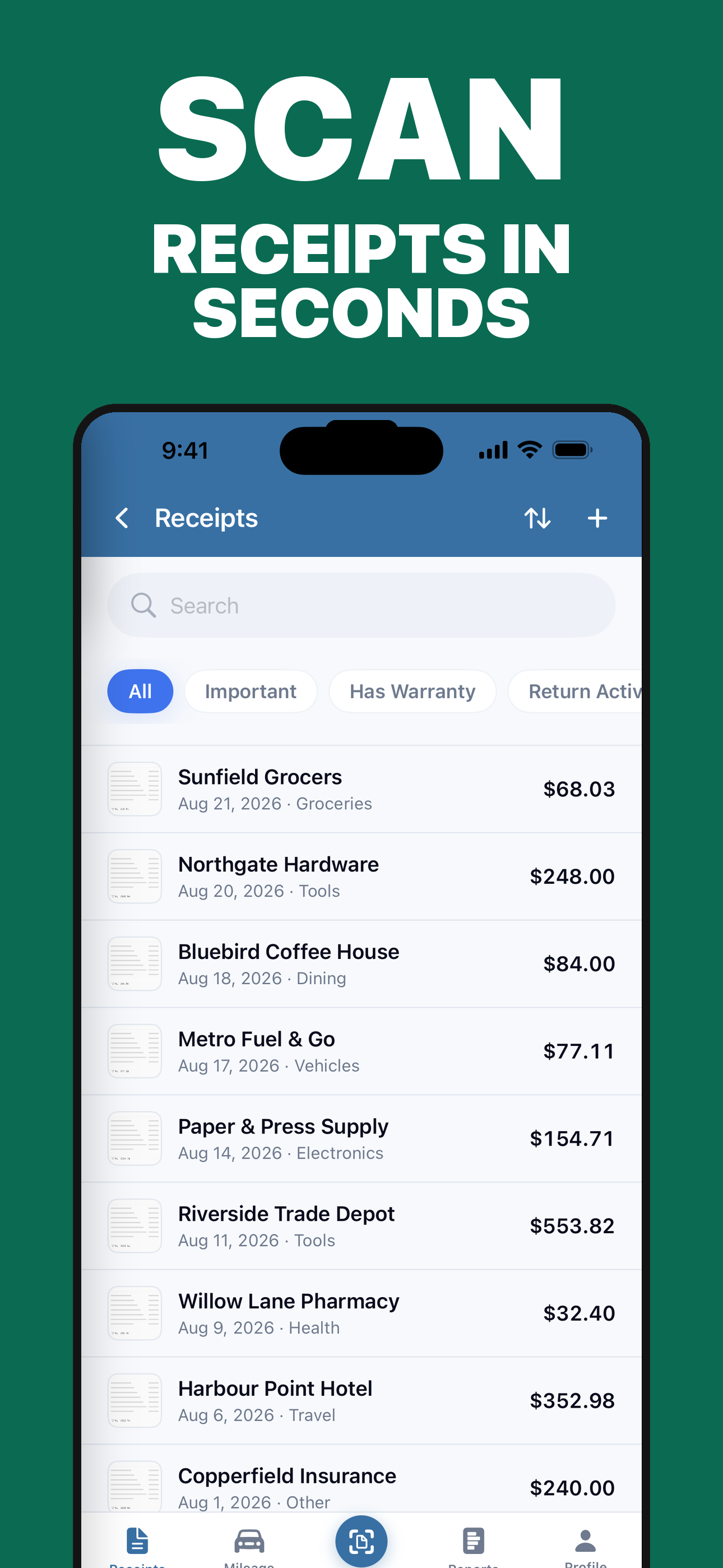
Where ReceGuard fits: ReceGuard scans receipts on your iPhone, reads the amount, date and merchant on the device, and keeps the image together with a business-purpose note. That gives you the receipt side of the pairing ready to attach to the invoice it settles, and an export for your accountant. Nothing in the app replaces the invoices you issue or the tax advice you need.
Frequently asked questions
Is an invoice the same as a receipt?
No. An invoice requests payment; a receipt confirms that payment was made. A single document can serve as both once it shows the payment date and method.
Can I deduct an expense with only an invoice and no receipt?
You can if you can also show that you paid it, for example with a card or bank statement line that matches the invoice. For expenses of $75 or more, the IRS expects documentary evidence such as a receipt or a paid bill.
Which should I give a client after they pay me?
Send a receipt, or the original invoice marked as paid with the payment date. It protects both sides and gives the client a record for their own books.
Does the IRS require a specific invoice format?
No. The IRS requires records that substantiate your income and deductions, but it does not set a template. Include enough detail to identify the parties, the work, the amount and the date.
When do I report income, at the invoice or at payment?
On the cash method, when you receive the payment. On the accrual method, generally when you earn the right to it, which is usually when you issue the invoice. Confirm your method with a tax professional.
Are scanned copies of invoices and receipts acceptable?
Yes, provided they are legible and can be reproduced on request, as set out in IRS Revenue Procedure 97-22. Back them up somewhere you control.
Sources
- IRS: Recordkeeping for small businesses
- IRS: Publication 463, Travel, Gift, and Car Expenses
- IRS: Publication 583, Starting a Business and Keeping Records
- IRS: Publication 538, Accounting Periods and Methods
- IRS: Revenue Procedure 97-22, electronic storage of records
This article is general recordkeeping information, not tax advice. Rules change and circumstances differ; a qualified tax professional should make the final call on your return.
Scan receipts, log mileage and export a tax package when you need one.
Download ReceGuard