 ReceGuard

Quick answer: how long should you keep receipts for taxes?
For most self-employed people, three years from the date you file the return that uses the receipt. That is the IRS default, because it is normally how long the IRS has to assess more tax or you have to claim a refund. Some situations stretch it to six or seven years, or remove the limit entirely, and records for equipment and other property must be kept much longer.
A simple working rule is to keep everything for seven years, and to keep asset records for as long as you own the asset plus seven years. Digital copies are fine if they are legible and you can produce them on request.
Key takeaways
- The general federal rule is 3 years after you file, not 3 years after the purchase.
- If you leave out more than 25% of the gross income shown on your return, the IRS has 6 years, so keep records for 6.
- Claiming a loss from worthless securities or a bad-debt deduction means keeping the records for 7 years.
- With no return filed, or a fraudulent one, there is no time limit at all.
- Records for property, including equipment and vehicles, must be kept until the limit expires for the year you sell or dispose of the property.
- States set their own limits, so check yours before you throw anything away.
What is the general rule for keeping tax records?
Keep records for 3 years from the date you file your original return, unless one of the special situations below applies. If you later file a claim for a credit or refund, the IRS says to keep them for 3 years from the filing date or 2 years from the date you paid the tax, whichever is later. Both rules are set out on the IRS page on how long to keep records, and they follow the legal time limit for the IRS to assess additional tax under 26 U.S.C. §6501.
The underlying obligation is broader than any single number. The regulation on records and statements says records must be kept for as long as their contents may become material to the administration of any tax law. The three-year figure is the practical answer to that sentence for an ordinary return.
One detail catches people out: the clock starts when the return is filed, and a return filed before the due date is treated as filed on the due date. So a receipt from January 2026 that supports a return filed in April 2027 needs to be kept until at least April 2030, more than four years after the purchase.
When do you need to keep records for longer than 3 years?
Whenever the IRS has a longer window to challenge the return. The IRS lists these cases on its records retention page, and they map to the statute of limitations on assessment:
| Situation | How long to keep the records |
|---|---|
| The standard case | 3 years from filing |
| You did not report income that was more than 25% of the gross income on your return | 6 years from filing |
| You claim a loss from worthless securities or a bad-debt deduction | 7 years |
| You have employees (employment tax records) | At least 4 years after the tax is due or paid, whichever is later |
| You did not file a return, or the return is fraudulent | Indefinitely |
| Property: equipment, a vehicle, a computer | Until the limit expires for the year you dispose of it |
The 25% rule is worth understanding because it is the reason many accountants say six. For a freelancer, a forgotten 1099 that pushes unreported income past a quarter of reported income turns a three-year window into a six-year one, and you will not know in advance whether that applies to you.
How long do you keep records for equipment, vehicles and other assets?
Until the limitations period ends for the tax year in which you sell or otherwise dispose of the asset. The receipt is not only proof of a deduction in the year you bought it; it also establishes your cost basis, which you need to work out the gain or loss when you sell.
A worked example: you buy a laptop for $2,400 in February 2026 and deduct it that year. You sell it in November 2029. The year of disposal is 2029, so the three-year clock runs from the filing of the 2029 return in spring 2030 and ends in spring 2033. The purchase receipt has to survive until then, roughly seven years after you bought it. IRS Publication 583 describes this property rule and lists the kinds of records to keep.
The same logic applies to a home office if you own the home, to a vehicle you use for business, and to anything you depreciate over several years.
Which records count, and does it matter what format they are in?
Anything that supports an item on your return counts, and the format is not the issue. The IRS recordkeeping guidance lists sales slips, paid bills, invoices, deposit slips, canceled checks and credit card statements as supporting documents, and it accepts electronic copies. Revenue Procedure 97-22 sets the conditions for an electronic system: the images must be legible, indexed so you can find them, and reproducible as a hard copy if the IRS asks.
Keep together, for each expense, the receipt, proof of payment, and a note of the business purpose. Two records are easy to forget because they are not receipts:
- Mileage logs. A car deduction has stricter substantiation rules than most expenses, so a log is kept as long as the return that relies on it. Our mileage log guide covers what each entry needs.
- The return itself. Keep a copy of every filed return and its supporting schedules; they are the easiest way to see what you claimed when a notice arrives years later.
Can you throw away the paper receipt once you have scanned it?
Generally yes, as long as the scan meets the electronic-records conditions and you can reproduce it on request. Check three things before you shred: the image is complete (both sides if there is writing on the back), every figure is readable, and the file is stored somewhere you will still be able to open in seven years. Thermal paper fades within a year or two, which is a good reason to digitize early. If you did lose a receipt before scanning it, see how to still prove a business expense.
Retention also applies to the copy. A scan that lives only on a phone with no backup is one lost device away from being no record at all, so back the folder up somewhere you control.
Do state tax rules change how long to keep receipts?
They can. State departments of revenue set their own assessment periods, and some are longer than the federal one, particularly when a federal audit changes your income and you owe additional state tax. Sales tax records are governed by state rules too. Check your state tax agency’s recordkeeping page; where it is longer than the federal period, keep the records for the longer one.
What does a real retention timeline look like?
Take a freelance designer who files on time each April. The table shows when each record from tax year 2026 can safely go, using the rules above and the seven-year working habit:
| Record from 2026 | Minimum (IRS default) | Working rule |
|---|---|---|
| Software subscription receipt | Until April 2030 (3 years after filing in April 2027) | April 2034 |
| Client invoice and payment record | Until April 2030 | April 2034 |
| Laptop bought in 2026, still in use | Until the limit for the year it is sold or scrapped | Disposal year plus 7 years |
| Copy of the filed 2026 return | Not applicable | Indefinitely |
The last column is not a legal requirement. It exists because a single, generous rule is easier to follow than five careful ones, and because the extra storage costs almost nothing.
Which recordkeeping mistakes cost the most?
- Counting from the purchase date. The clock starts when you file, so a receipt from early in the year outlives the three-year mark by months.
- Shredding asset receipts with the rest. A receipt for equipment is not a one-year record. Losing it can leave you unable to prove your basis at sale.
- Keeping only the card statement. A statement proves payment, not what you bought or why. Keep the receipt or invoice as well.
- Ignoring the state. A federal date is not a state date.
- Deleting while a notice is open. If you receive an IRS letter, stop clearing out records for the years involved until it is closed.
What is a practical system for deciding what to keep?
Set one retention rule for the whole business, so you never make a case-by-case decision under pressure. A workable version:
- Keep every expense record for 7 years from the date you file the return. This covers the 3-year default, the 6-year case and the 7-year bad-debt case with one rule.
- Keep asset records until you dispose of the asset, then 7 more years. Store them in a folder labelled with the asset, not the year.
- Keep employment tax records for at least 4 years, and treat them like any other record beyond that.
- Keep copies of filed returns indefinitely. They cost almost nothing to store.
- Review once a year when you file. Delete what has aged out of the window; keep what is tied to an open asset.
This is a conservative habit, not a legal requirement. If storage is not a constraint, which it rarely is for digital files, the cost of keeping a record for an extra few years is close to zero and the cost of missing one is not. Our receipt organization guide shows how to file records so that finding them later takes a minute, and the free business expense record builder helps you write down the purpose of an expense while you still remember it.
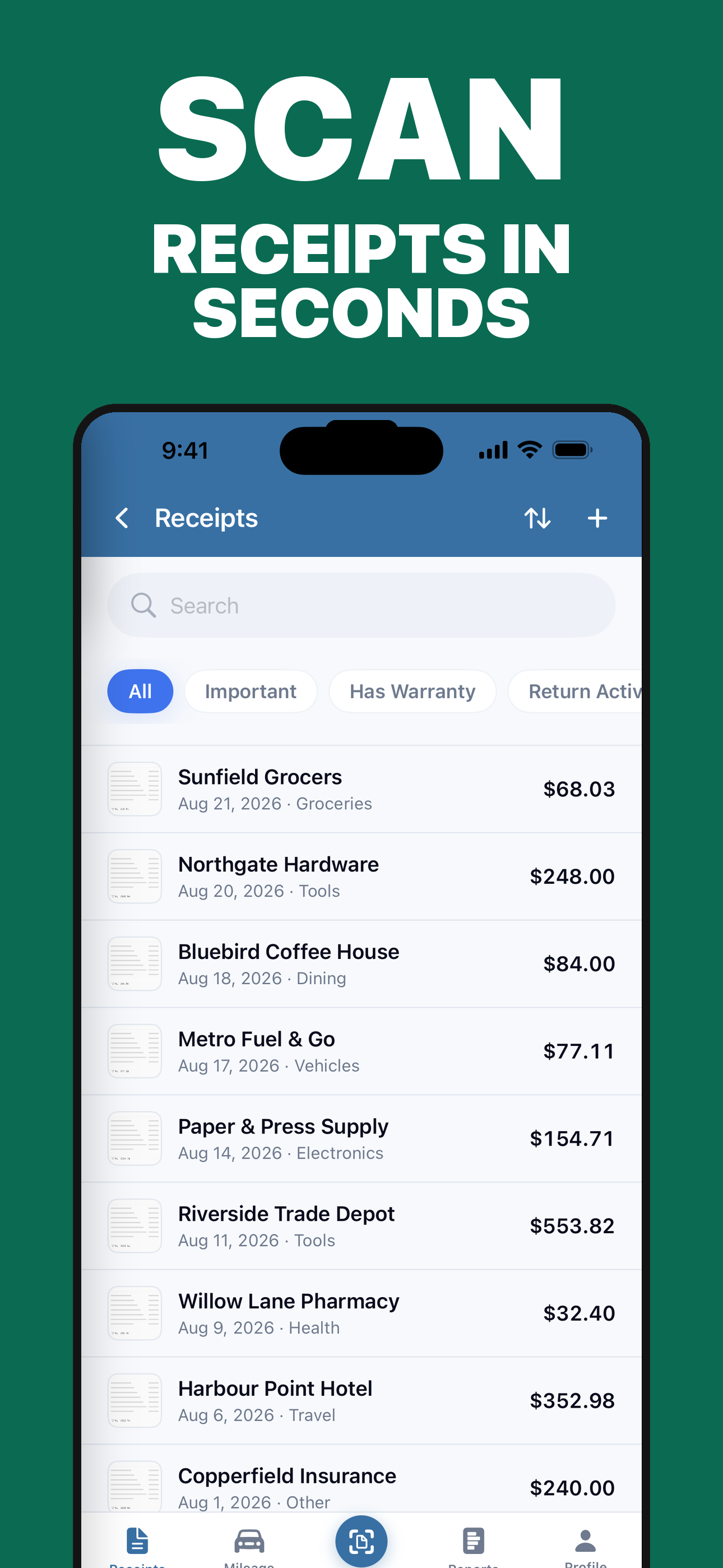
Where ReceGuard fits: receipts scanned with ReceGuard are read on your iPhone and stored with the amount, date, merchant and business purpose, so the record you need in year five is already labelled and searchable. Exports can be produced when your accountant or an examiner asks. What you keep, and for how long, stays your decision.
Frequently asked questions
How long do I need to keep receipts for a self-employed tax return?
The federal default is three years from the date you file the return that uses them. It is longer, six or seven years, if you underreport income by more than 25% or claim a bad-debt or worthless-securities loss, and unlimited if no return was filed. Many advisers simply keep everything for seven years.
Does the 3-year clock start when I buy something or when I file?
When you file. A return filed early counts as filed on its due date. A receipt from early in the tax year therefore has to be kept for more than three years after the purchase.
How long should I keep receipts for equipment I depreciate?
Until the limitations period expires for the year you sell or dispose of the equipment. The receipt proves your cost basis, which you need to calculate gain or loss at sale, so it can be needed many years after the purchase.
Can I keep only digital copies of my receipts?
Yes, if the images are legible, complete and can be reproduced on paper on request, as Revenue Procedure 97-22 requires. Keep them somewhere backed up and searchable.
Are state records rules the same as the IRS rules?
Not always. States set their own assessment periods and some are longer than the federal three years. Check your state tax agency and follow the longer of the two periods.
What if I already threw away old receipts?
If the period has passed and you filed on time, you are normally fine. If a return is still open, rebuild what you can from card statements and account histories, and write a dated note about what is missing.
Sources
- IRS: How long should I keep records?
- IRS: Recordkeeping for small businesses
- IRS: Publication 583, Starting a Business and Keeping Records
- IRS: Revenue Procedure 97-22, electronic storage of records
- Cornell Law School LII: 26 U.S.C. §6501, limitations on assessment and collection
- Cornell Law School LII: 26 CFR §1.6001-1, records
This article is general recordkeeping information, not tax advice. Rules change and circumstances differ; a qualified tax professional should make the final call on your return.
Scan receipts, log mileage and export a tax package when you need one.
Download ReceGuard